Problem A. 1. Circular shield
Input file name: standard input
Output file name: standard output
Time limit: 1 s
Memory limit: 1024 MB
Output file name: standard output
Time limit: 1 s
Memory limit: 1024 MB
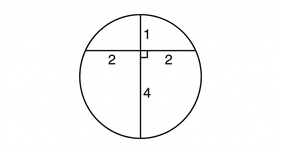
During an excavation, an archaeologist discovers the remains of an ancient circular shield. The outer rim is completely destroyed, but two intersecting iron support bars remain intact.
Through careful measurement, the archaeologist determines that these two bars were perfectly perpendicular to each other. The intersection point divides the first bar into two segments of lengths a and b, and the second bar into two segments of lengths c and d.
Given the lengths of these four segments, your task is to calculate the total area of the original circular shield. However, due to the passage of time, some of the archaeologist's measurements might be flawed. If the given segments cannot possibly form a valid circle under the described conditions, you must report that the measurements are invalid.
Through careful measurement, the archaeologist determines that these two bars were perfectly perpendicular to each other. The intersection point divides the first bar into two segments of lengths a and b, and the second bar into two segments of lengths c and d.
Given the lengths of these four segments, your task is to calculate the total area of the original circular shield. However, due to the passage of time, some of the archaeologist's measurements might be flawed. If the given segments cannot possibly form a valid circle under the described conditions, you must report that the measurements are invalid.
Input
The first and only line of input contains four space-separated integers: a, b, c, d (1 \le a, b, c, d \le 10^4), representing the lengths of the segments. The first bar is split into a and b, and the second perpendicular bar is split into c and d.
Output
If the measurements can form a valid circle, output a single floating-point number: the area of the original circular shield. Your answer will be considered correct if its absolute or relative error does not exceed 10^{-4}. If the measurements cannot possibly form a valid circle, output -1.
Any standard notation (including scientific) is acceptable.
Any standard notation (including scientific) is acceptable.
Examples
| standard input | standard output |
|---|---|
| 2 2 1 4 | 19.634954 |
| 2 3 1 7 | -1 |
Note
This is how shield from the first example would look like: