Problem A. 3. Equal area
Input file name: standard input
Output file name: standard output
Time limit: 1 s
Memory limit: 1024 MB
Output file name: standard output
Time limit: 1 s
Memory limit: 1024 MB
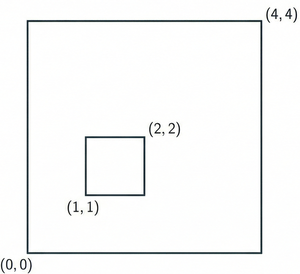
You are given two axis-aligned rectangles. The second rectangle is strictly smaller than the first and is located entirely inside it. The smaller rectangle represents a hole in the larger one.
Your task is to find a straight line defined by the equation y = ax + b that cuts the resulting shape (the area of the large rectangle minus the area of the hole) into two pieces of exactly equal area.
It is guaranteed that resulting line will not be vertical.
Input
The input consists of two lines:
- The first line contains four space-separated integers X_1, Y_1, X_2, Y_2 (-10^6 \le X_1 < X_2 \le 10^6, -10^6 \le Y_1 < Y_2 \le 10^6) — the coordinates of the bottom-left and top-right corners of the larger rectangle.
- The second line contains four space-separated integers x_1, y_1, x_2, y_2 (-10^6 \le x_1 < x_2 \le 10^6, -10^6 \le y_1 < y_2 \le 10^6) — the coordinates of the bottom-left and top-right corners of the smaller rectangle.
Output
Print two real numbers, a and b (-10^{12} \le a, b \le 10^{12}), representing the equation of the cutting line y = ax + b.
Your answer will be considered correct if the line divides the shape into two parts such that the absolute or relative difference between their areas does not exceed 10^{-6}.
Examples
| standard input | standard output |
|---|---|
| 0 0 4 4 1 1 2 2 | 1 0 |
| 0 0 6 4 1 1 3 2 | 0.5 0.5 |
Note
Example image of sample test 1: